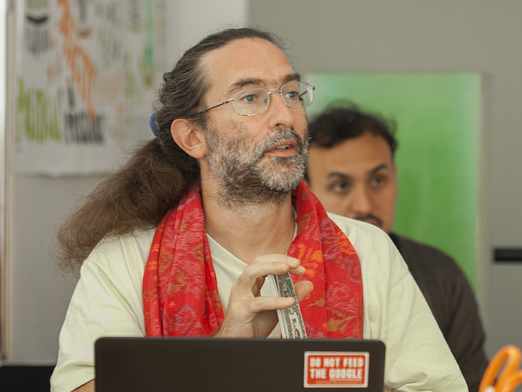

The Collaborative Finance Gathering began as a collaboration between me and the CommonsHub in Austria to gather people and projects I had befriended in my career. Because I firmly believe that no single initiative can build and maintain a money system to compete with legal money, a broad coalition of initiatives seemed a strategic no-brainer.
The first gathering was about meeting each other and creating a common vocabulary. I brought a strong facilitating hand and structured the event around 'structures of credit'. This worked very well because almost every project fit into the structure, and I received several comments from people who hadn't realised, they had been talking about the same thing but with different words.
I was delighted when Stephen DeMeulenaere joined me for the second and actually shouldered most of the burden from then on. Stephen's approach was different though. As an elder, he saw our role as holding space - not to guide, not to lecture. The next two events were pretty good, and we saw relationships growing and even yes, collaborations happening within the space. As founder though, I faced two challenges.
- Firstly Cofi, conceived as an alternative to various cryptocurrency narratives, was struggling to break of the technical discourse and engage actual local and community projects. In January 2024 I invited all the complementary currency projects I could think of, and barely received a single response from any of them. There were probably many reasons for this. local projects don't see themselves as global actors with some dogmatically regarding themselves as local infrastructure, many lack english speakers, they already had software, they didn't want to invest €1000 and a week of somebody's time, and many of them hadn't heard of me or Community Forge. Their absence was a blow to #CoFi because who was all the software for if not for those practitioner communities? I reflected in a recent article on the chasm between software and practice.
- Without both of these groups present, I didn't see a strong need for collaboration just between software developers. If local groups were really the priority, #CoFi would need to meet them where they were, not attempt to summon them to Austria.
This year, the annual gatherings ran out of road. Despite a lively Telegram group with over 300 people, the Commons Hub was only half full. Its time to change something.
Both Stephen and I started in the field of complementary currencies. This work is often fueled by revelations that money is not what it seems, and needs to be otherwise. The activism reaches in two directions:
- To replace some or all money as we know it with something less toxic to the soul and to Gaia. This usually means creating liquidity circuits between businesses, or local vouchers for use on the high street.
- To provide new community infrastructure to account for non-financial exchange, often with the goal of building trust and cooperation. This includes LETS, timebanks, DAOs and a host of other creative ideas that rarely get implemented.
But it seems to me that money is not, and perhaps never was, a vector for change, a point of leverage in the system. It's just too entrenched, not only in law but in people's sense of self and sense of security. That's why even the most successful projects have made no measurable contribution either to alleviating poverty or to planting trees. No-one in the movement seems to worry about this lack of tangible impact. Perhaps we are blinded by ideology, or wedded to hubristic middle class notions of system change without getting our hands muddy. With no impact, our work all hangs on a story that when the dark night of capitalism gives way to the golden dawn of solar punk, perhaps the people of the near future will stop re-inventing the wheel and treasure case studies in failure that we barely even bothered to document.
Collaborative Finance is not about holding the candle until the time is ripe for monetary reform, but about building infrastructure that serves us now. On the principle of diversifying risk, ordinary people need to diversify away from Big Finance and towards local communities. In the context of the 19th Century working people were able to build large and useful financial institutions such as cooperatives and building societies, some of which survive to this day. But those institutional forms belong to the age of the industrial revolution, a strong state, paper-based bureaucracy. The march of globalism, technology, and fascism makes us ever more dependent on psychopathic corporations and genocidal governments in all things and especially finance. #CoFi is whatever pushes against that.
Small, local groups are of course financially more risky, but they have other important benefits - they provide a financial diversity insulated from general collapse, but they also diversity away from finance itself, by investing in real-world high trust relationships which some characterise as social capital.
There are many legal and practical obstacles to creating financial services and some things are too important to risk with friends and neighbours. Nonetheless, many potentially useful interventions remain possible even at the small scale:
- saving and lending
- liquidity circuits for local business
- insurance of certain things
- financing small businesses
- co-investing
- private money transmission (like the Islamic Hawala mechanism)
Examples are quite rare in the over-banked Western world, but other eras and civilisations are littered with examples of small scale informal financial arrangements.
It seems to me that we have all we need to build useful financial infrastructure. We have software engineers of course, but also currency designers, project managers, communicators, strategists, bureaucrats, fundraisers, academics and even some bridges into other sectors and social movements which might provide context and complements to our work. What holds us back from impact is stories of self and organisational mandates that prevent us from identifying a shared achievable goal. Lets always remember that that most impactful, long lasting projects in the space are built and maintained by teams of people committed to the same thing over many years, not projects chasing 3 year grants.
People have to decide for themselves where they want to push. In my opinon, if I'm not relieving suffering, stewarding nature, or building actually needed infrastructure, I'm probably not making the world a better place. The game of building a mass movement is to find the centre of gravity, then let go of my ideology, and fall in.
I've been thinking about what's next for me. My special skill is to remain in awe and incomprehension at things everyone else seems to understand intuitively, and then finally to grok the thing, to understand why everyone was asking the wrong question and misunderstanding each other, to see the connection between it and every other point in the universe, and then to be able to communicate that. This is one reason the subject of money appealed to me in the first place, its why I've always wanted to teach, and its why the Money & Society MOOC I created with Jem Bendell won me more fans than all the LETS web sites I support. So I'm looking for ways to express my intellectual gifts, whether through writing, teaching, workshops, or mentoring.
In my mind #CoFi is a potential banner or schelling point for groups and communities to brush up on financial literacy and choose from a menu of financial and software tools then do finance as part of a larger network which is essential for providing stability. I will lay more groundwork for this as time allows.
The next gathering, if and when it happens, will be much more locally focused and low-budget, more the 2024 #CoFi2 retreat in Ezemaal than like the global gatherings in Commons Hub. Stay tuned to the Telegram Channel!
Comments